
Does a Supplement Recall Match Your Bottle?
When a recall headline resembles the name on your supplement bottle, compare the complete notice with the package in your hand. The FDA's consumer recall guide says to check the product description, package size and identifying codes, and follow the notice's specific instructions.
This Peak Men Care guide explains a reading task. It does not announce a recall of any product sold here, and it does not certify any product as recall-free. Illustrations are fictional editorial examples, not real labels or official recall notices.
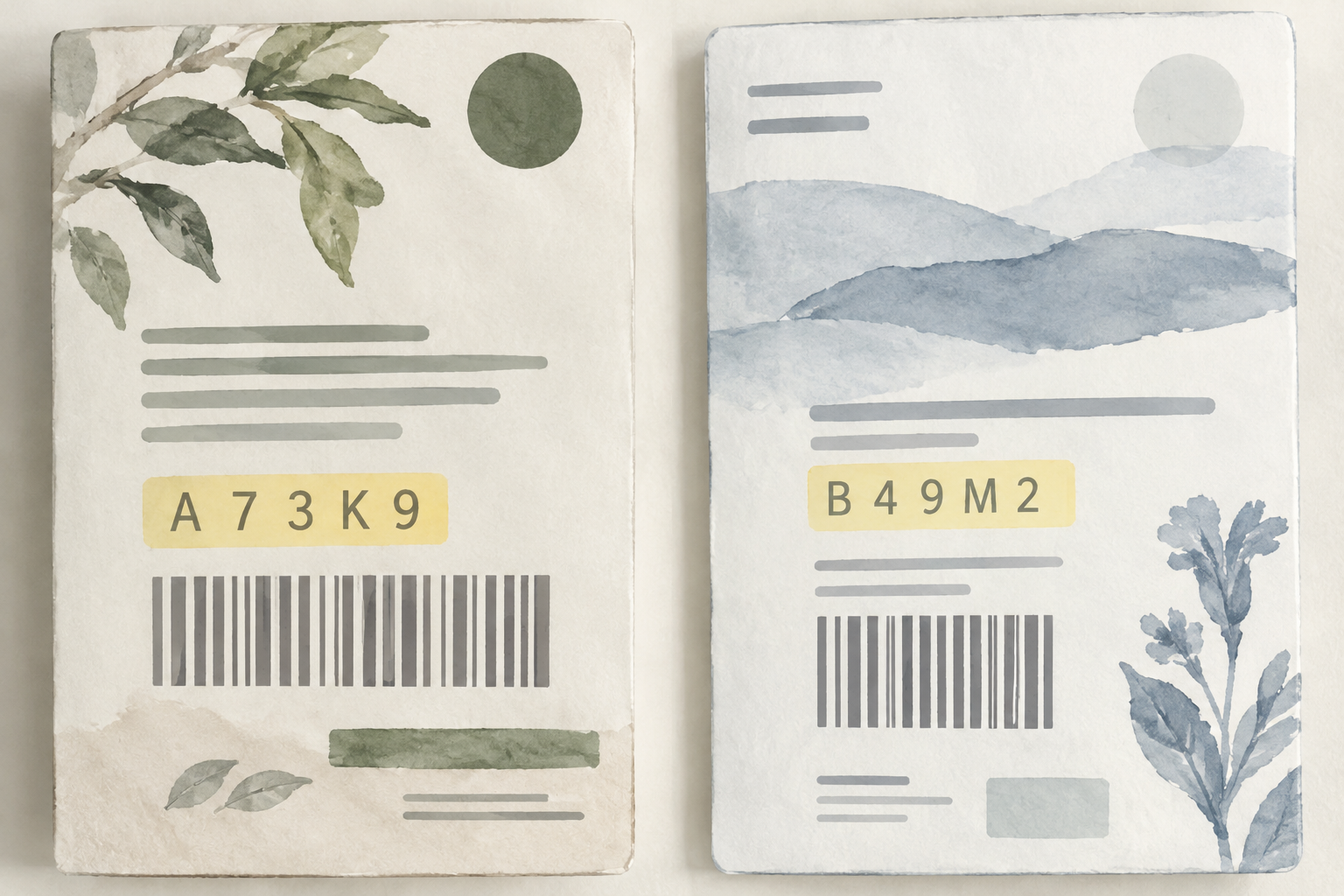
Open the notice before comparing the name
The FDA recall and safety-alert page is one starting point. The agency explicitly says that not every recall appears on that page. A search with no matching headline is therefore not proof that a supplement is safe or has never been recalled.
In its consumer guide, FDA explains that notices may identify products by brand, package size, UPC, lot codes, dates, pictures and distribution details. Read those fields together. Do not replace the notice's scope with a guess based on a similar-looking label.
Put the notice and bottle side by side
Our suggested worksheet has two columns: “notice says” and “my package says.” Copy each field exactly before deciding whether it matches. Leave a blank for information you cannot read; do not fill it from memory.
Here is a deliberately fictional example. An imaginary notice covers “Example Supplement, 30 capsules, lot DEMO-A.” Your imaginary bottle says “Example Supplement, 30 capsules, lot DEMO-B.” The name and quantity agree, but the lot differs. That comparison alone is not a general safety verdict, and it does not overrule another notice that covers all lots.
Now change the example: the notice says “all lots.” In that situation, looking for a different lot code would not establish an exception. The point of the example is to read the scope as written, not to find a reassuring mismatch.
Keep the fictional codes in this example out of a real enquiry. They exist only to demonstrate the worksheet.
Treat an unreadable code as an open question
If the code is smudged, our suggested enquiry is: “I have this product and package size. I cannot read the final characters of the lot code. Here are clear photos of the front, back and printed code. Does your recall cover this package?”
Send that to the contact identified in the actual notice. FDA advises contacting the company for further information and says not to use a product you think has been recalled. Follow the notice's return or disposal directions; do not give a recalled product to someone else. FDA's instructions for consumers explain these next steps.
For your own record, keep the notice link, the date you checked it, photographs and the response together. Our suggested filename is simply the product name plus the date, so you can find the material without recreating the search.
Keep product identification separate from health care
If you feel ill after using a product, FDA advises contacting your healthcare provider and reporting the issue. Matching a lot code is an administrative task; it should not become a reason to postpone care.
The useful outcome is specific: either you have identified the package against the notice and followed its directions, or you have a clearly documented question waiting for the named contact. “It looks similar” and “I did not find it” are not equivalent to those outcomes.